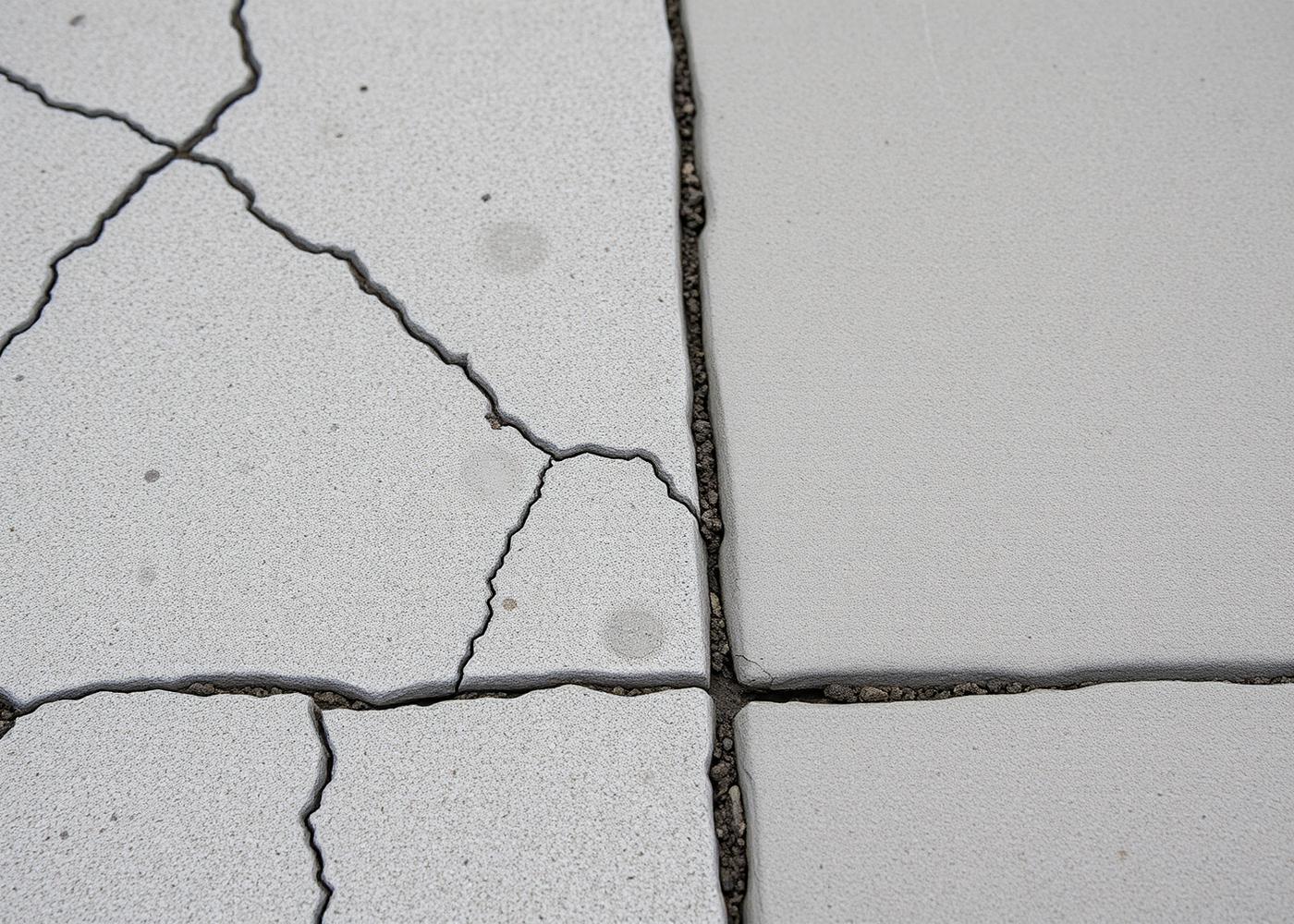
Repair
Concrete Repair in Reno, NV
Cracks, spalling, trip hazards, failed joints and worn surfaces — assessed for cause first, then repaired in a way that holds.
- We repair
- Driveways, patios, walkways, steps, garage and shop floors
- Typical fixes
- Rout and seal, patching, resurfacing, panel replacement
- Always first
- Find the cause — surface, joint or subgrade
- Straight answer
- If replacement is the better value, we say so
Repairing concrete without understanding why it failed usually means paying twice. A crack caused by shrinkage is a different problem from one caused by a washed-out base, and the second will reopen through any patch you put on it.
This page walks through the damage types we see across Reno and Sparks, what each one means, and which repair actually fits. Related reading: crack repair specifics, resurfacing worn slabs, the repair versus replacement decision, and repair pricing factors.
Damage types and what they usually mean
| What you see | Likely cause | Usual approach |
|---|---|---|
| Hairline cracks following joints | Normal shrinkage | Clean and seal to keep water out |
| Wide or offset cracks | Base movement or missing reinforcement | Evaluate subgrade; panel replacement often wins |
| Flaking, pitted surface (spalling) | Freeze-thaw, de-icing salts, weak surface | Patch or resurface |
| Sunken panel at a joint | Base erosion or poor compaction | Lift or replace the panel |
| Popouts | Reactive aggregate near the surface | Cosmetic patching |
| Crumbling edges at driveway apron | Thin edges plus vehicle loads | Rebuild the edge section |
| Dusting interior floor | Over-watered or poorly cured surface | Densify or resurface |
Freeze-thaw is the driver behind most of the surface damage in this region. Water gets into pores and cracks, freezes overnight, expands, and lifts material away. Sealed, well-drained slabs age far better than neglected ones — which is why driveway maintenance matters more here than in mild climates.
Repair methods we use
Rout and seal
Cracks are widened into a clean channel, cleaned out and filled with a flexible sealant that can move with the slab. Best for stable cracks where water intrusion is the concern.
Structural crack repair
Epoxy injection or stitching where the crack needs to transfer load again. Only appropriate when the underlying cause has been corrected.
Partial-depth patching
Deteriorated surface concrete is removed to sound material and replaced with a bonded repair mortar. Used on spalled aprons, steps and edges.
Full-depth panel replacement
One or more slab sections are saw-cut, removed, the base is corrected, and new concrete is placed with dowels tying it to the neighbors. Often the right call for a single failed driveway panel.
Resurfacing / overlay
A bonded overlay restores the wear surface across a slab that is structurally sound but ugly. Details on the resurfacing page.
Joint maintenance
Old, failed joint sealant gets removed and replaced. Cheap, unglamorous, and one of the highest-value things you can do before winter.
When repair stops making sense
Repair is the better value when damage is localized, the slab is thick enough for its use, and the base is stable. Lean toward replacement when:
- Cracking is widespread and map-like rather than isolated
- Multiple panels have settled or heaved relative to each other
- The slab is thinner than it should be for the vehicles or loads using it
- Repairs have already been made and keep failing in the same places
- Surface deterioration is deep rather than a thin scaled layer
The repair or replace guide sets out the decision points, and replacement cost factors explain the budget side. For driveways and patios specifically, see driveway replacement and patio replacement.
What a repair estimate accounts for
- Extent and depth of damage, and how much sound concrete must be removed
- Access for equipment, and disposal of removed material
- Whether the base needs correction beneath the repair
- Materials — sealant, repair mortar, overlay product, new concrete
- Color and texture matching expectations (a repair is a repair; it will be visible)
- Timing, since cold weather limits which products can be applied
Details are on the concrete repair cost page. Repairs on driveways, patios, walkways and garage floors each have their own quirks, covered on those pages.
Questions we get asked
Concrete Repair in Reno, NV: common questions
Are hairline cracks in concrete a problem?
Usually not structurally. Concrete shrinks as it cures and hairline cracking is expected, especially along control joints. Sealing them keeps water and de-icer out, which is what turns a cosmetic crack into a real problem over a few winters.
Can a sunken slab be lifted instead of replaced?
Sometimes. Slab lifting works when the concrete itself is sound and the void beneath it can be filled. If the slab is broken into multiple pieces or badly under-thick, replacement is the more durable answer.
Will a repair match the color of my existing concrete?
No repair matches perfectly. Existing concrete has weathered and stained for years. Repairs can be blended and textured to be much less noticeable, but expecting an invisible patch is unrealistic.
What time of year is best for concrete repair in Reno?
Spring through fall gives the widest choice of materials, since many sealants, patching products and overlays have minimum temperature requirements. Urgent safety repairs can be handled in winter with products rated for cold conditions.
Related concrete services & guides
Where we do this work
Crews work throughout the Reno–Sparks area. Pick your community for local notes on soils, permitting and typical projects.
Free project estimates
Talk through your concrete project with someone who pours it
Describe the area, the condition of any existing concrete and how you want to use the space. You'll get straight answers on scope, sequencing and what drives the price.
Next step
Get a site-specific estimate
Concrete pricing depends on access, subgrade, thickness, reinforcement and finish, so real numbers come from looking at the site. Send the details or call (775) 324-5551.
- Walk-through of the area and existing concrete condition
- Scope, thickness, reinforcement and finish options in writing
- Clear explanation of what would change the price
- No pressure to decide on the spot